
How To Calculate Withholding Tax In Nigeria: A Simple Guide For Everyone
If you are a business owner, freelancer, or even just someone who receives payments in Nigeria, you might have heard about withholding tax (WHT). It’s one of those taxes that can be confusing at first, but with the right guidance, it’s easy to understand and calculate. In this article, we will break it down in a simple, step-by-step way.
What Is Withholding Tax (WHT) In Nigeria?
Withholding tax is a type of advance tax deduction. Essentially, it is the amount of tax that a company or individual deducts at the source before paying a recipient. The recipient can later claim this tax as a credit against their final income tax liability.
In Nigeria, WHT is regulated by the Federal Inland Revenue Service (FIRS) and state tax authorities. It applies to both individuals and companies, and the rates differ depending on the type of transaction.
In simpler terms, imagine you’re paying someone for services or rent. Instead of the recipient paying the tax later, you deduct a certain percentage upfront and remit it to the tax authorities.
Why Withholding Tax Matters
Understanding and applying WHT is important for a few reasons:
Legal Compliance
- Failing to deduct or remit WHT can lead to penalties and fines from tax authorities.
Financial Planning
- Knowing WHT helps you budget accurately for payments to contractors, suppliers, or employees.
Tax Credits
- For the recipient, WHT is not a final tax; it is credited against their annual income tax, reducing the amount they owe at the end of the year.
Who Should Deduct Withholding Tax?
In Nigeria, anyone making certain types of payments is required by law to deduct WHT. This includes:
- Companies paying contractors for goods or services
- Individuals making payments to service providers
- Organizations paying dividends, interest, or rent
The payer is responsible for deducting the tax and remitting it to the relevant tax authority.
Types Of Payments Subject To Withholding Tax
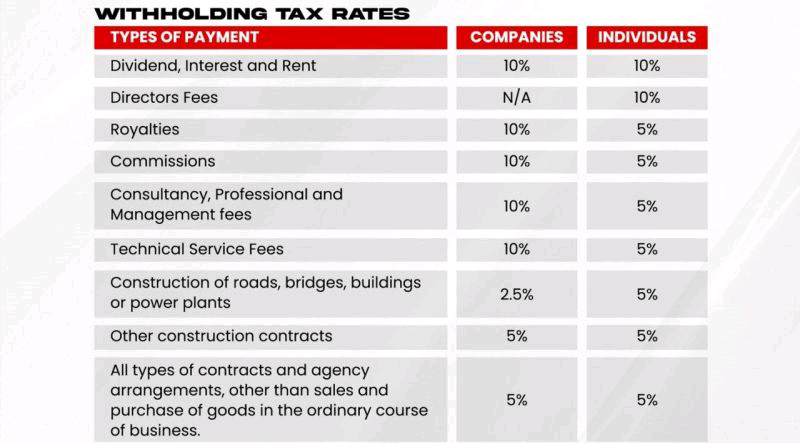
Here’s a breakdown of common payments and their WHT rates in Nigeria:
| Payment Type | Individual Rate | Company Rate |
|---|---|---|
| Dividends | 10% | 10% |
| Interest | 10% | 10% |
| Rent | 10% | 10% |
| Professional Services | 5% | 5% |
| Contracts (Goods/Works) | 5% | 5% |
| Management Fees | 10% | 10% |
Tip: Always confirm the current rates with the FIRS or your state tax authority, as rates may change.
Step-By-Step Guide: How To Calculate Withholding Tax In Nigeria
Calculating WHT may sound complicated, but it’s actually straightforward if you follow these steps.
Step 1: Identify The Type Of Payment
Determine what type of payment you are making. Is it:
- Payment for services?
- Rent for a property?
- Dividends to shareholders?
The type of payment determines the WHT rate.
Step 2: Check the Applicable Rate
Refer to the table above or the latest FIRS guidelines to find the correct rate.
For example:
- Professional services = 5%
- Rent = 10%
Step 3: Calculate The Tax
Use the formula:
- \text{Withholding Tax} = \text{Payment Amount} \times \text{Applicable Rate}
Example 1: You are paying a contractor ₦500,000 for professional services.
- Rate = 5%
- WHT = 500,000 × 5% = ₦25,000
Example 2: You are paying ₦200,000 in rent.
- Rate = 10%
- WHT = 200,000 × 10% = ₦20,000
Step 4: Deduct The Tax Before Payment
The WHT amount is deducted from the total payment, and the net amount is paid to the recipient.
Example: For the ₦500,000 professional service payment:
- Total payment = ₦500,000
- WHT = ₦25,000
Amount paid to contractor = ₦500,000 − ₦25,000 = ₦475,000
Step 5: Remit The Tax To The Tax Authority
The deducted WHT must be remitted to the FIRS or state tax office. This is usually done monthly, and you must provide a WHT remittance form.
Step 6: Issue A Withholding Tax Certificate
After remitting, you should provide the recipient with a WHT certificate. This serves as proof of tax deducted and allows them to claim it as a credit against their income tax.
Examples Of Withholding Tax In Nigeria
Example 1: Paying a Freelance Graphic Designer
- Payment = ₦300,000
- Service = Professional service (WHT 5%)
- WHT = 300,000 × 5% = ₦15,000
- Net payment = 300,000 − 15,000 = ₦285,000
The freelancer receives ₦285,000, and you remit ₦15,000 to the tax authority.
Example 2: Paying Rent To A Landlord
- Payment = ₦150,000
- Payment type = Rent (WHT 10%)
- WHT = 150,000 × 10% = ₦15,000
- Net payment = 150,000 − 15,000 = ₦135,000
The landlord receives ₦135,000, and ₦15,000 is remitted to the tax authority.
Withholding Tax And Tax Credits
The recipient of the payment can use the WHT certificate to reduce their annual tax liability. For example:
- If a contractor earns ₦1,000,000 in a year and ₦50,000 has been deducted as WHT, they only pay tax on the remaining ₦950,000.
This system ensures that tax is collected efficiently and reduces the risk of tax evasion.
Common Mistakes To Avoid
- Not deducting WHT: Leads to penalties.
- Using wrong rates: Always check the FIRS or state guidelines.
- Not remitting on time: WHT must be remitted monthly to avoid fines.
- Failing to issue certificates: The recipient needs this to claim tax credits.
How Businesses Can Simplify WHT Management
For companies handling multiple payments:
- Use accounting software to automatically calculate WHT.
- Keep detailed records of all payments and deductions.
- Train your finance team on current WHT regulations.
- Consult tax professionals to avoid compliance issues.
Recent Changes In Withholding Tax In Nigeria
The Nigerian government occasionally updates WHT rules and rates. Some states have introduced their own WHT systems, so it’s important to:
- Check with FIRS for federal WHT
- Check with your state tax authority for local WHT
- Keep records of changes for audit purposes
Benefits Of Understanding Withholding Tax
- Avoid penalties – Compliance keeps your business safe.
- Better Cash Flow Management – Knowing WHT allows accurate payments.
- Ease In annual Tax Filing – WHT certificates simplify tax returns.
- Transparency In Tansactions – Both payers and recipients know the exact amounts.