
Withholding Tax Rate In Nigeria: A Complete Guide For Individuals And Businesses
Withholding tax is a crucial part of Nigeria’s tax system, but many people find it confusing. Whether you are an employee, a business owner, or someone involved in financial transactions, knowing how withholding tax works is essential. This guide will break down everything you need to know about withholding tax in Nigeria.
What Is Withholding Tax?
Withholding tax (WHT) is a tax deducted at the source of income. This means that instead of paying tax directly to the government at the end of the year, the tax is taken from your payment before you receive it. In Nigeria, both individuals and companies can be subject to withholding tax, depending on the type of income.
The Nigerian government uses withholding tax to collect revenue efficiently and to reduce tax evasion. It is also a prepayment of income tax. At the end of the year, the amount withheld is credited against your total tax liability.
Who Is Required To Deduct Withholding Tax?
In Nigeria, withholding tax can be deducted by:
- Employers paying salaries to employees
- Companies making payments to contractors or service providers
- Banks or financial institutions paying interest
- Companies distributing dividends to shareholders
The person or entity making the payment is responsible for deducting the tax and remitting it to the Federal Inland Revenue Service (FIRS) or the State Internal Revenue Service (SIRS).
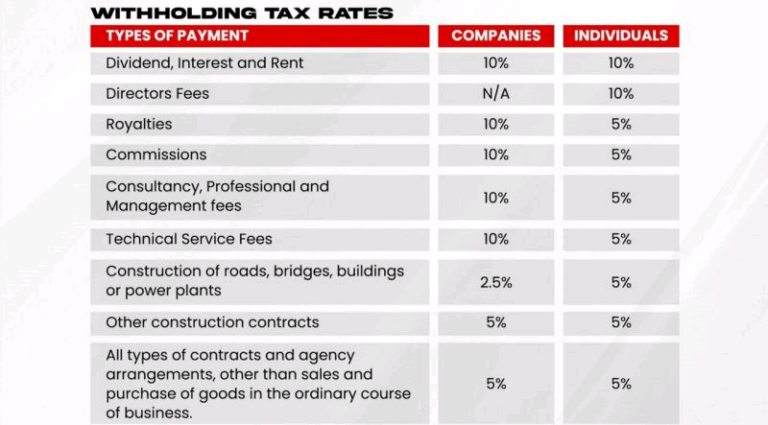
Withholding Tax Rates In Nigeria
The withholding tax rates vary depending on the type of transaction and whether the payment is made to an individual or a company. Below is a simplified table of common WHT rates in Nigeria:
| Transaction Type | Individual Rate | Company Rate |
|---|---|---|
| Dividends | 10% | 10% |
| Interest | 10% | 10% |
| Rent | 10% | 10% |
| Professional Services | 5% | 5% |
| Contracts (Goods/Works) | 5% | 5% |
| Management Fees | 10% | 10% |
Note: Rates may differ slightly depending on the state, as states in Nigeria also collect withholding tax for services rendered within their territory.
How To Calculate Withholding Tax
Calculating withholding tax is straightforward. You multiply the payment amount by the applicable withholding tax rate. For example:
- If you pay a contractor ₦500,000 for services and the WHT rate is 5%, the tax to deduct is ₦500,000 × 5% = ₦25,000.
- The contractor receives ₦475,000, and the ₦25,000 is remitted to the tax authority.
Remittance Of Withholding Tax
The tax deducted must be remitted to the government within a specified period, usually within 30 days from the end of the month in which the deduction was made. Non-compliance can result in penalties or fines.
Withholding Tax Certificates
Once the WHT is remitted, the payer issues a Withholding Tax Certificate to the recipient. This certificate is proof of tax already paid and can be used to offset your annual income tax liability.
For example, if your total income tax for the year is ₦100,000, and you have paid ₦25,000 as WHT, you will only need to pay ₦75,000 when filing your annual tax return.
Benefits Of Withholding Tax
Reduces Tax Evasion
Since tax is collected at the source, it minimizes the risk of underreporting income.
Prepayment For Taxpayers
Individuals and companies pay part of their annual taxes in advance.
Boosts Government Revenue: It ensures a steady inflow of funds to the government.
Common Mistakes To Avoid
Failure to Deduct: Some businesses forget to deduct WHT, which can lead to penalties.
- Late Remittance: Not submitting the deducted tax on time can attract fines.
- Incorrect Rate: Applying the wrong rate can lead to disputes with tax authorities.
- Not Issuing Certificates: Failing to give WHT certificates to recipients may affect their tax filing.
Withholding Tax And Businesses
Businesses must pay close attention to WHT because it affects cash flow and tax compliance. Companies must:
- Deduct the correct tax rate
- Remit the tax promptly to the government
- Maintain accurate records of all deductions
- Issue WHT certificates to beneficiaries
State vs Federal Withholding Tax
In Nigeria, both the Federal and State governments can levy withholding tax. Generally:
- Federal WHT applies to most business transactions.
- State WHT applies to payments for services rendered within a particular state, such as professional fees, contracts, and rent.
Each state has its own WHT rates and remittance process, so businesses operating in multiple states need to comply with each jurisdiction.
How Withholding Tax Affects Individuals
For employees, WHT is typically deducted from salaries under the Pay-As-You-Earn (PAYE) system. The amount deducted is credited against their annual income tax. This ensures that employees do not have a large tax burden at the end of the year.
How To Reduce Withholding Tax Liability Legally
Tax Exemptions: Some transactions are exempt from WHT. For example, certain government payments or exports may be exempt.
- Claiming Tax Credits: Use WHT certificates to offset your annual tax liability.
- Proper Structuring Of Payments: Certain payments can be structured to reduce unnecessary WHT.
Penalties For Non-Compliance
Failure to comply with WHT regulations can lead to penalties, including:
- Fines for late remittance
- Interest on unpaid taxes
- Legal action by tax authorities
- Difficulty in obtaining tax clearance certificates
Frequently Asked Questions – (FAQs)
Is Withholding Tax Refundable?
Yes, any excess withholding tax paid can be claimed as a credit against your annual income tax liability.
Who Is Responsible For Remitting WHT?
The entity making the payment (payer) is responsible for deducting and remitting WHT to the tax authorities.
Can WHT Rates Change?
Yes, WHT rates can be revised by federal or state governments. Always check the latest tax regulations.
What Is A WHT Certificate?
It is a document issued by the payer confirming that tax has been deducted and remitted to the government.
Does WHT Apply To Foreign Companies?
Yes, certain payments to non-resident companies, such as royalties and management fees, may attract WHT in Nigeria.